
Nikon D7100 User Manual: A Comprehensive Guide
Welcome to a new experience with this guide for the Nikon D7100! Explore repair manuals, features, functionality, and safety guidelines within this comprehensive resource.
The Nikon D7100 is a powerful and versatile DSLR camera, favored by enthusiasts and professionals alike. This manual serves as a comprehensive guide, unlocking its full potential. It details everything from initial setup to advanced shooting techniques. Explore resources like Nikon’s official website and online communities for support.
Discover detailed information on features, functionality, and crucial safety guidelines. Whether you’re a beginner or experienced photographer, this manual will enhance your photographic journey with the D7100.
Key Features and Specifications
The Nikon D7100 boasts a 24.1-megapixel DX-format CMOS sensor, delivering exceptional image quality and detail. It features a 51-point autofocus system for precise subject tracking, and continuous shooting at up to 6 frames per second. Key specs include a 3.2-inch tilting LCD screen and 1080p Full HD video recording.
This camera offers a wide ISO range, enhancing low-light performance. Explore its robust build quality and extensive customization options, making it a reliable tool for diverse photographic endeavors.

Getting Started
Begin your photographic journey! This section guides you through unboxing, initial setup, understanding controls, and inserting essential components like the battery and memory card.
Unboxing and Initial Setup
Carefully unpack your Nikon D7100, ensuring all included accessories are present – body, battery, charger, strap, USB cable, and documentation. Before first use, thoroughly inspect the camera for any physical damage. Insert the battery into the designated compartment and the memory card into its slot.
Initial setup involves selecting your language, date, and time. Register your camera online for warranty benefits and access to Nikon’s support resources. Familiarize yourself with the kit contents and prepare for a rewarding photographic experience!
Understanding the Camera Body and Controls
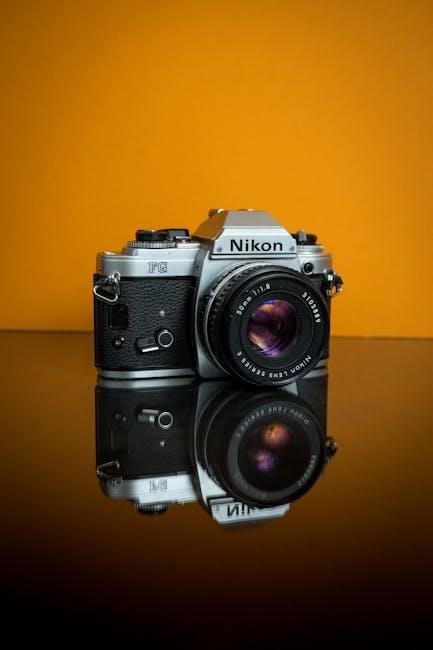
The Nikon D7100 boasts a robust build with strategically placed controls. Key elements include the mode dial for selecting shooting modes, the shutter button, and front/rear control dials for adjusting settings. Explore the function buttons, customizable for quick access to frequently used features.
The viewfinder provides a clear view of your scene, while the LCD screen displays settings and images. Understanding the location and function of each control is crucial for efficient operation and creative control.
Inserting the Battery and Memory Card
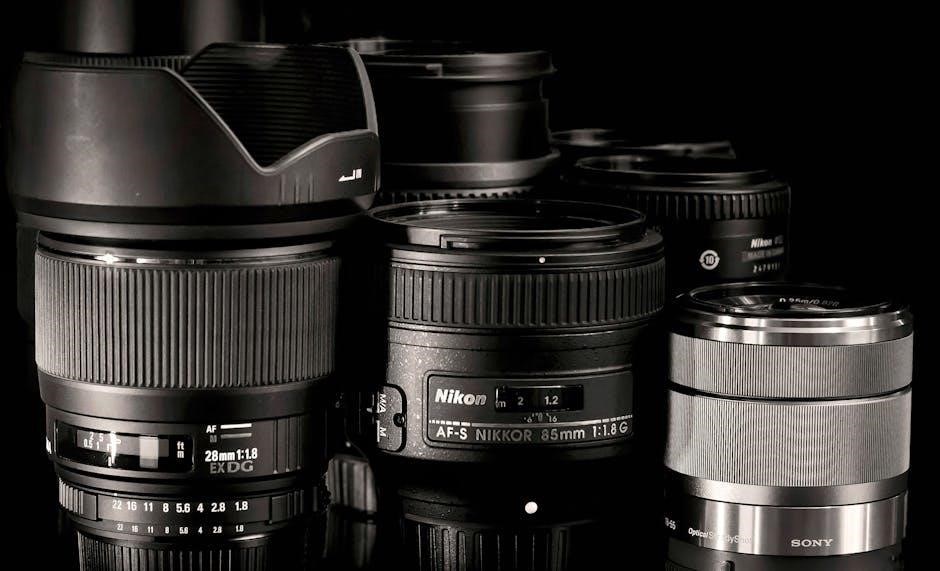
Properly inserting the battery and memory card is the first step to using your Nikon D7100. Locate the battery compartment door, typically on the bottom of the camera, and insert the EN-EL15 battery with the correct orientation. Ensure it clicks into place securely.
Next, open the memory card slot door and insert a compatible SD card (SDHC or SDXC) label-side up; Gently push until it locks. Always power off the camera before inserting or removing either component.
Basic Operation
Master fundamental controls! Learn powering on/off, navigating the menu, and understanding focus modes for seamless shooting with your Nikon D7100 camera.
Powering On/Off and Basic Shooting Modes
Initiating Operation: To power on your Nikon D7100, locate the main power switch, typically positioned around the shutter button. Slide it to the ‘ON’ position. The camera will initialize, displaying the shooting screen. To power off, return the switch to ‘OFF’.
Essential Shooting Modes: The mode dial offers various options. ‘Auto’ simplifies settings for beginners. ‘Program’ (P) allows some control while automating others. ‘Aperture Priority’ (A/Av) lets you set the aperture, while the camera adjusts shutter speed. ‘Shutter Priority’ (S/Tv) controls shutter speed, and ‘Manual’ (M) grants full control. Explore these modes to understand their impact on image creation.
Navigating the Menu System
Accessing the Menu: Press the ‘Menu’ button on the rear of the Nikon D7100 to reveal the comprehensive menu system. Utilize the multi-selector and sub-command dial to navigate through the various menu tabs – Setup, Shooting, Custom Settings, etc.
Menu Structure: Each tab contains numerous settings categorized for ease of use. The ‘i’ button provides quick access to frequently used settings. Understanding the menu’s logical structure is key to customizing your camera and optimizing performance. Explore each section to unlock the D7100’s full potential.
Understanding Focus Modes and Areas
Focus Modes: The Nikon D7100 offers several focus modes – Auto-area AF, Single-area AF, Dynamic-area AF, 3D-tracking, and Auto AF. Each mode suits different shooting scenarios. Single-area AF is ideal for stationary subjects, while 3D-tracking excels with moving targets.
Focus Areas: Select from various focus area options to pinpoint your desired focus point. Utilize the multi-selector to move the focus area across the frame. Mastering these modes and areas ensures sharp, well-focused images consistently.

Advanced Shooting Techniques
Unlock your D7100’s potential! Master aperture, shutter speed, ISO, exposure compensation, and Picture Control settings for stunning, professional-quality photographs.
Aperture, Shutter Speed, and ISO Explained
Understanding the Exposure Triangle is crucial. Aperture controls depth of field – a lower f-number creates a shallow depth, blurring backgrounds. Shutter speed dictates motion blur; faster speeds freeze action, slower speeds allow for creative blur.
ISO measures the sensor’s sensitivity to light. Lower ISOs (like 100) produce cleaner images, while higher ISOs (like 3200 or higher) are useful in low light but introduce noise. Balancing these three settings is key to achieving properly exposed and visually appealing photographs with your Nikon D7100.
Working with Exposure Compensation
Exposure compensation overrides the camera’s automatic metering. Use it when the camera consistently underexposes or overexposes scenes. The scale is typically marked in stops (+/- EV), allowing precise adjustments.
Positive values brighten the image, useful for dark subjects, while negative values darken it, ideal for bright scenes like snow. Experiment to find the optimal setting for your specific shooting situation on the Nikon D7100, ensuring accurate and pleasing results.
Utilizing Picture Control Settings
Picture Control settings tailor the look of your images directly in-camera. The Nikon D7100 offers presets like Standard, Neutral, Vivid, and Monochrome. Each adjusts parameters like sharpness, contrast, brightness, and saturation.
Customize these presets or create your own for a unique style. Experiment with the settings to achieve desired results, saving time in post-processing. Picture Control is a powerful tool for creative control over your photographs.
Focusing and Metering
Master advanced autofocus, metering modes, and focus lock techniques. Achieve sharp, properly exposed images with the Nikon D7100’s versatile focusing and metering systems.
Advanced Autofocus Settings
Dive into the Nikon D7100’s sophisticated autofocus system. Explore AF-S, AF-C, and AF-A modes for static, moving, or unpredictable subjects. Customize focus area modes – Single-point, Dynamic-area, 3D-tracking, and Auto-area – to match your shooting scenario.
Fine-tune tracking sensitivity and lock-on behavior for precise subject acquisition. Utilize focus priority, release priority, and continuous AF settings for optimal performance. Understand the impact of lens compatibility on autofocus speed and accuracy. Experiment with back-button focus for enhanced control.
Metering Modes and Their Applications
Master exposure with the Nikon D7100’s metering system. Understand Evaluative (matrix), Center-weighted, and Spot metering modes. Evaluative metering excels in general situations, while Center-weighted prioritizes the center of the frame. Spot metering precisely measures light from a small area, ideal for challenging lighting.
Learn when to use each mode for portraits, landscapes, and high-contrast scenes. Explore metering point lock for consistent exposure. Utilize exposure compensation alongside metering modes for creative control and accurate results.
Focus Lock and Back-Button Focus
Enhance focusing control with the Nikon D7100. Focus lock allows you to separate focusing and shooting. Lock focus on your subject, recompose the shot, and capture the image. Explore back-button focus, assigning autofocus to the AF-ON button.
This decouples focusing from the shutter release, providing greater control. Back-button focus is ideal for tracking moving subjects and maintaining sharp focus during continuous shooting. Customize settings for optimal performance.
Working with Flash
Master flash photography with your Nikon D7100! Learn about built-in features, external flash utilization, compensation techniques, and synchronization modes for stunning results.
Built-in Flash Features
The Nikon D7100’s integrated flash offers versatile lighting solutions for various shooting scenarios. It functions effectively as a primary light source in low-light conditions, illuminating subjects clearly. Additionally, it serves as a fill flash to reduce harsh shadows when shooting in bright sunlight.
Explore modes like Auto, Manual, and Rear-Curtain Sync to control flash output and timing. Utilize the flash exposure compensation function for precise adjustments. Remember to consider the guide number for optimal power settings and achieve balanced, well-lit photographs effortlessly.
Using External Flashes
Expanding your lighting capabilities, the Nikon D7100 seamlessly integrates with a wide range of Nikon Speedlights. Attaching an external flash provides increased power, flexibility, and creative control over your images. Explore advanced features like TTL (Through-The-Lens) metering for automatic exposure, or switch to manual mode for precise adjustments.
Utilize the camera’s commander function to wirelessly control compatible flashes. Experiment with off-camera flash techniques for dramatic lighting effects and professional-looking results. Remember to check flash compatibility for optimal performance.
Flash Compensation and Synchronization
Fine-tune your flash exposure with flash compensation, adjusting the output power for brighter or darker results. This is crucial for balancing flash with ambient light. Synchronization settings determine when the flash fires relative to the shutter.
Utilize high-speed sync (HSS) for faster shutter speeds, overcoming the camera’s flash sync speed limitation. Understand front-curtain and rear-curtain sync for creative effects. Proper synchronization ensures sharp, well-exposed images, avoiding dark bands or motion blur.

Video Recording
Master video setup, settings, and audio considerations for optimal results. Explore options for recording high-quality videos with your Nikon D7100 camera.
Setting Up for Video Recording
Preparing your Nikon D7100 for video recording involves several key steps. First, ensure a formatted memory card is inserted with sufficient space. Select the ‘Movie’ mode on the mode dial. Next, adjust the aperture, shutter speed, and ISO for desired exposure, considering the lighting conditions;
Pay attention to white balance settings for accurate color representation. Connect an external microphone for improved audio quality, if needed. Finally, choose your desired frame rate and resolution within the camera’s menu system to optimize your video output.
Video Recording Settings and Options
The Nikon D7100 offers diverse video recording settings. Resolution choices include 1080p Full HD at various frame rates (24p, 25p, 30p, 50p, 60p). Picture Control settings impact video aesthetics, allowing for customization of color and contrast.
Adjust audio levels manually or utilize auto-leveling. Explore options for movie output size and quality. The camera supports uncompressed HDMI output for external recording. Experiment with these settings to achieve your desired video look and professional results.
Audio Recording Considerations
Achieving quality audio is crucial for compelling videos. The Nikon D7100 features a built-in microphone, but external microphones significantly enhance sound. Consider a shotgun microphone for focused audio or a lavalier mic for interviews;
Monitor audio levels carefully using the camera’s display to prevent clipping or excessively low volume. Wind noise can be problematic; utilize a windscreen. Experiment with manual versus auto audio level control for optimal results in diverse environments.

Customization and Settings
Personalize your D7100! Explore custom function settings, My Menu customization, and saving/loading settings for a tailored shooting experience and efficient workflow.
Custom Function Settings
Unlock the D7100’s full potential with Custom Function settings! These allow you to tailor the camera’s operation to your specific shooting style. Assign controls, modify button behavior, and streamline workflows. Explore options for autofocus, metering, display, and more.
Customize functions to quickly access frequently used settings, enhancing efficiency. Experiment to find configurations that perfectly match your preferences. Remember to document your changes for easy recall or replication. This level of personalization truly makes the D7100 your own.
My Menu Customization
Personalize your Nikon D7100 experience with ‘My Menu’! This powerful feature lets you create a dedicated menu tab containing only the settings you use most often. Add items from any of the camera’s main menus for instant access.
Organize settings logically for a faster, more intuitive workflow. Remove clutter and focus on what matters. ‘My Menu’ significantly speeds up adjustments in the field, ensuring you never miss a shot while searching through complex menus. It’s a key to efficient operation!
Saving and Loading Settings
Preserve your preferred camera configurations with the D7100’s settings saving function! Store customized setups – for landscapes, portraits, or action – to memory cards. Easily recall these settings when facing similar shooting conditions.
This eliminates repetitive menu diving and ensures consistent results. You can save up to 20 custom settings. Loading a saved setting instantly adjusts numerous camera parameters, streamlining your workflow and maximizing efficiency in diverse photographic scenarios.

Troubleshooting Common Issues
Resolve typical D7100 problems quickly! Address focus errors, exposure difficulties, and decipher error messages with this guide’s practical solutions and clear explanations.
Addressing Focus Problems
Is your Nikon D7100 struggling to achieve sharp focus? Several factors can contribute to this. First, ensure you’ve selected the appropriate focus mode – Single-servo (AF-S) for stationary subjects and Continuous-servo (AF-C) for moving ones. Verify your focus area mode is suited to the scene.
Experiment with different focus points or utilize dynamic-area AF. Check lens compatibility and ensure the lens is securely attached. Clean the lens contacts and sensor. If issues persist, consider recalibrating the autofocus system or seeking professional assistance.
Resolving Exposure Issues
Are your Nikon D7100 images consistently too bright or too dark? Begin by checking your shooting mode – are you in Auto, Program, Aperture-priority, Shutter-priority, or Manual? Understand how aperture, shutter speed, and ISO interact to control exposure. Utilize the exposure compensation dial to fine-tune brightness.
Review your metering mode selection (Matrix, Center-weighted, Spot) for optimal results. Ensure Picture Control settings aren’t drastically altering the image. If problems continue, examine your histogram for accurate exposure assessment.
Dealing with Error Messages
Encountering error messages on your Nikon D7100 can be concerning, but often easily resolved. First, note the specific error code displayed – consult the camera’s manual for its meaning. Common issues include card errors (reformat or try a different card), lens communication problems (clean contacts), or battery issues (charge or replace).
Restarting the camera often clears temporary glitches. If the error persists, research the code online or contact Nikon support for assistance. Avoid forcing operations when an error is present.
Maintenance and Care
Protect your investment! Regularly clean the body and lens, properly store batteries, and keep the firmware updated for optimal Nikon D7100 performance.
Cleaning the Camera Body and Lens
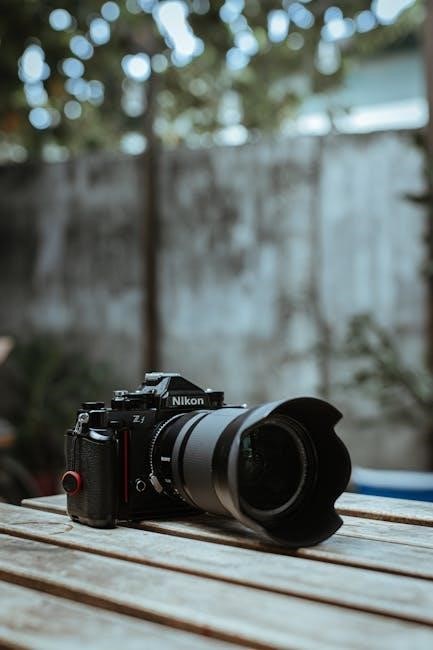
Maintaining pristine condition is crucial for your Nikon D7100. Use a soft, dry microfiber cloth to gently wipe the camera body, removing dust and fingerprints. For stubborn marks, slightly dampen the cloth with lens cleaning fluid – never apply liquid directly to the camera.
Lens care requires extra attention. Employ a blower to remove loose particles, followed by a lens brush in a circular motion. Use lens cleaning tissue and fluid for smudges, ensuring a streak-free finish. Avoid harsh chemicals or abrasive materials that could damage the coating.
Battery Care and Storage
Maximize your Nikon D7100’s battery life with proper care. Avoid extreme temperatures, as heat degrades battery performance. When not in use for extended periods, remove the battery and store it in a cool, dry place – ideally around 70°F (21°C).
Never fully discharge the battery before recharging. Partial charges are preferable. Use only the Nikon-supplied charger to prevent damage. Avoid short-circuiting the terminals, and do not disassemble or incinerate the battery. Proper storage ensures longevity.
Firmware Updates
Keep your Nikon D7100 performing optimally by installing the latest firmware. Regularly check Nikon’s official website for updates, as these often include bug fixes, enhanced compatibility, and new features. Download the firmware file and follow Nikon’s detailed instructions carefully during the update process.
Ensure the battery is fully charged and the camera remains powered on throughout the update. Interrupting the process can cause irreversible damage. Firmware updates are crucial for maintaining camera functionality and security.
Resources and Support
Access Nikon’s official website, online forums, and communities for assistance. Explore repair manuals and service information to enhance your D7100 experience!
Nikon’s Official Website and Support
Nikon’s official website is the primary hub for comprehensive D7100 support. Here, you’ll discover downloadable manuals, frequently asked questions, and troubleshooting guides designed to address common user concerns. Direct support options, including contact forms and potentially live chat, are available for personalized assistance.
The website also provides access to software and firmware updates crucial for maintaining optimal camera performance and compatibility. Regularly checking for these updates ensures your D7100 functions smoothly and benefits from the latest enhancements. Explore Nikon’s extensive knowledge base for detailed articles and tutorials.
Online Forums and Communities
Engage with fellow Nikon D7100 users in vibrant online forums and communities! Platforms like Nikon Club Ufficiale offer spaces to share experiences, ask questions, and receive advice from experienced photographers. These communities are invaluable resources for troubleshooting issues and discovering advanced techniques.
Benefit from collective knowledge, participate in discussions, and find solutions to unique challenges. Many forums host dedicated sections for the D7100, ensuring relevant and focused support. Explore user-submitted tips, reviews, and custom settings for enhanced creativity.
Repair Manuals and Service Information
Accessing detailed repair manuals and service information is crucial for advanced users and technicians. While official Nikon service documentation may be restricted, resources like The Manual Library offer downloadable PDFs related to the D7100. These can aid in understanding the camera’s internal workings and potential repair procedures.
However, attempting self-repair without proper training can void warranties and cause further damage. Consider professional service for complex issues. Explore available resources cautiously and prioritize safety when dealing with electronic equipment.